
Healthcare has never been more essential, or more capital-intensive. An ageing global population, rising chronic disease burden, and a continued wave of scientific innovation are driving demand for therapeutics, devices, and services to record levels, largely independent of the economic cycle. Yet the capital available to fund this growth has not kept pace, leaving a widening gap between what the sector needs and what traditional financing can supply.
The tailwinds for specialist healthcare credit are clear:
- The global population aged 65+ is projected to double to 1.6 billion by 2050 and will drive demand for therapeutics, devices, and services largely independent of the economic cycle. This trend is even more pronounced in the US and the EU — Hayfin’s core addressable markets — where post-war baby boomers are now entering retirement age. By 2030, more than 20% of the US population will be over 65, driving structurally higher healthcare utilisation.
- Healthcare’s share of GDP has risen consistently across developed economies over the past five decades — tripling in the US from 6% to 18% since 1970, and more than doubling in Japan and the UK, a trajectory that has held through recessions, rate cycles, and successive policy changes.
However, the capital required to fund this expansion is not:
- While R&D investment has grown more than 80% over the last ten years, approximately 60% of this is self-funded by the top 20 pharma groups.

- The remaining 40% must come from smaller companies that do not have balance sheets capitalised by portfolios of established drugs and products — these require external financing to fund their pipelines.
External healthcare financing has been highly cyclical
- There has been a decline of 73% in external biopharma funding from its 2020–2021 peak to its 2022–2023 trough, and funding remains at around 52% of peak levels today.
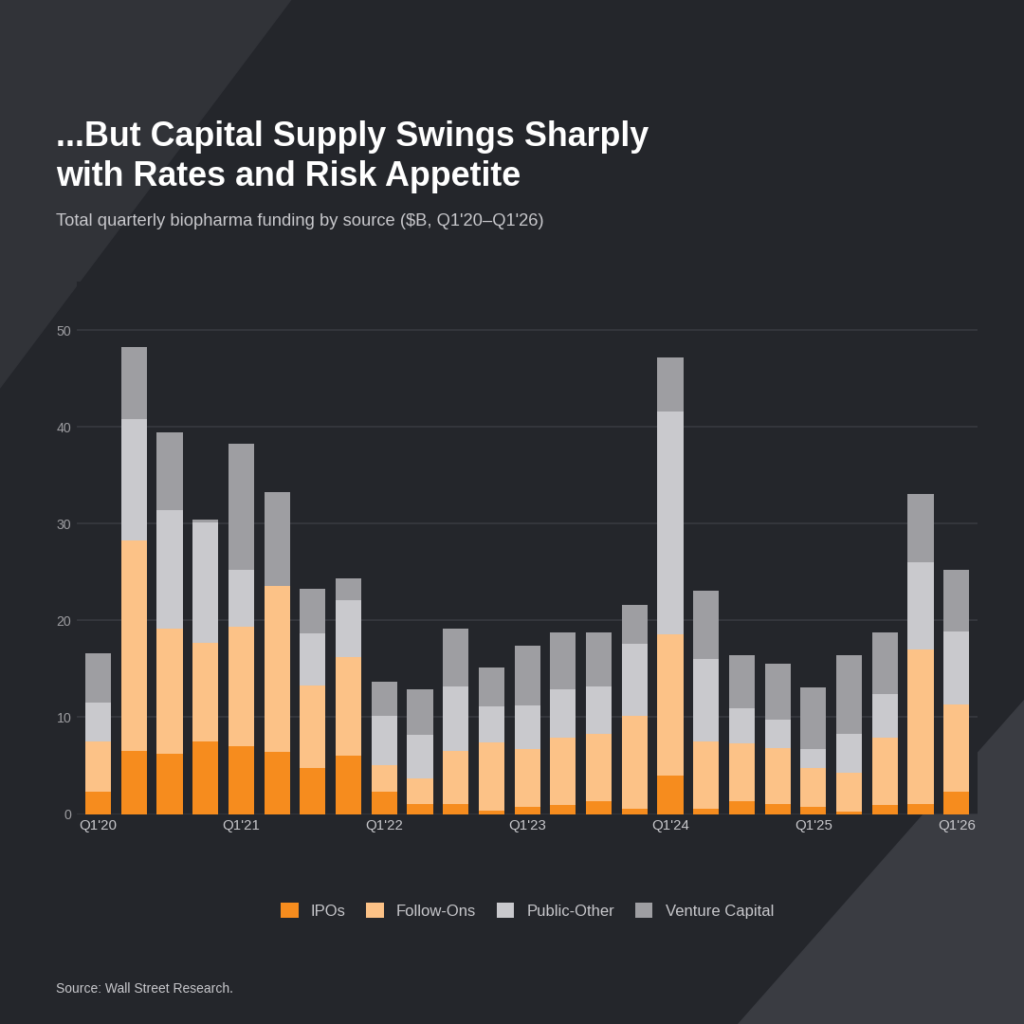
- Scaling healthcare companies with genuine assets and durable revenues are underserved: equity is too expensive or unavailable in the current environment, and traditional lenders are not yet accessible.
This is precisely where Hayfin’s Healthcare Strategy is designed to operate — providing flexible capital across the debt and equity spectrum, including equity capital replacement, mezzanine financing, and growth debt, with the sector expertise to underwrite complexity across biopharma, medical devices, and medical technology.
For more information on Hayfin’s healthcare strategy, please visit: hayfin.com/strategies/private-credit/healthcare
Further Reading: Examining Healthcare: Regulation and related implications for opportunistic allocation
When preparing to host Hayfin’s North American clients at our annual US AGM in New York last month, we knew three topics would be at the forefront of their thinking: software, retail redemptions and the Iran conflict. The discussion became a timely test of how private credit managers can demonstrate that they are the right partners to help investors navigate market volatility.
New AI models have triggered a repricing of business durability in the face of accelerating disruption, prompting LPs to examine their GPs’ exposure to potential losses in software, where private credit is often seen as heavily concentrated. At the same time, a surge in redemptions and gating in some US semi-liquid private credit vehicles has forced price discovery and raised the prospect of supply shocks. Finally, despite the fragile ceasefire reached in April, tensions in the Middle East continue to ripple through supply chains, commodities pricing and energy markets.
These three trends are playing out differently on either side of the Atlantic. In the case of the first two, the impact should in theory be more muted in Europe. Software is a smaller part of European lending than in the US, where it accounts for an estimated 20–25% of private credit activity. In Europe, higher-risk ARR lending to pre-profit software businesses with unclear paths to deleveraging is far less prevalent. Similarly, while retail capital has grown to 20–25% of global private credit AUM, withdrawals have been concentrated in US Business Development Company (BDC) and interval fund structures rather than in European vehicles, which are still relatively nascent.
But Europe is unquestionably more exposed to geopolitical risk – at least from the specific perspective of disruptions to energy supply and the resulting increase in inflation.
Is your money safe?
In all three cases, the first question that LPs should be asking their private credit managers is how they will preserve capital, protect value and limit downside risk within their existing portfolios.
We have previously explained why we remain underweight software across both our Private Credit and High-Yield & Syndicated Loans businesses. Our software exposure across Direct Lending portfolios is less than 6%, and below 5% in our latest vintage, which compares favourably with peers.
We have managed that exposure through prudent portfolio diversification and a clear view that software is not only potentially vulnerable to generative AI disruption, but also one of the most competitive parts of the market. Where we are invested, those loans are to large, mature, high-growth companies backed by sector specialist GPs. We have grounded our credit judgment in traditional credit metrics rather than uncertain enterprise value assumptions.
Uncertainty is not an environment we are waiting to pass. It is the environment we are built for.
We are similarly well placed on liquidity. Hayfin’s private credit strategies rely exclusively on fully locked-up institutional drawdown funds, with no retail capital. We had already been seeing growing demand for institutional vintage solutions that operate as drawdown vehicles, with redemptions achieved through natural portfolio run-off rather than forced asset sales. That trend now looks set to accelerate.
No manager, least of all one investing in Europe, can be fully insulated from the effects of conflict involving Iran. We saw during Covid and in the early stages of the war in Ukraine how shocks to energy, transport and agricultural supply chains can quickly spread through interconnected markets. Higher energy, fertiliser and freight costs would feed into food prices and create broader inflationary pressure.
Our dedicated Maritime team, with 15 industry specialists, more than $4 billion deployed and over 100 vessels acquired, gives us added insight into how global supply chains are being affected.
Where can managers create an edge?
The second question LPs should ask their GPs is how they are positioned to capitalise on these market dislocations. Throughout Hayfin’s history, periods like these have created the conditions for us to grow, gain market share, deepen relationships with borrowers and LPs, and deliver some of our best-performing investment vintages. Uncertainty is not an environment we are waiting to pass. It is the environment we are built for.
The obvious counterargument is that the private credit industry as a whole tends to gain market share from banks and syndicated markets during periods of disruption. The more important question, then, is what positions us to deliver compelling investment returns in a more uncertain environment relative to our competitors.
Our European focus is certainly an advantage. We consider ourselves the European home team, with 17 years of track record and a platform built to operate across fragmented jurisdictions, languages and legal regimes. The distinctive, longstanding opportunity set in Europe, as we have previously discussed, certainly still applies. There remains room for further growth, with the UK and EU’s combined GDP totaling 90% of the US, but with private markets just one third of the size. Additionally, as a shallower market than the US, Europe can reprice quicker in environments like this.
Hayfin’s adaptability and ‘one-firm’ culture, both of which I described earlier this year, are also well-suited for the current landscape. Our broad set of complementary strategies allows us to finance both growth and stress, and to lean into the parts of the market offering the best risk-adjusted returns, as this rapidly shifts around us. By operating in a de-siloed, integrated manner, when markets “flash amber”, we draw on the insights and experience of the whole team to re‑underwrite portfolios, reassess risks and recalibrate pipelines.
Recent market stresses will also affect future investment vintages. One potential second‑order effect of the recent strains in US private credit is that both LPs and borrowers will increasingly favour managers with more conservative approaches to fund structuring. US lenders might pull back from European markets, tipping competitive dynamics in favour of homegrown European managers with more institutional capital.
Patient capital – at scale
Many of the themes discussed here are only beginning to play out. We will remain patient, focusing first on supporting our existing borrowers as the market comes to us.
At the same time, we are preparing to invest selectively through our Tactical Solutions, Special Opportunities and Private Equity Solutions strategies. In these areas, choppier markets and a rising tide of €300 billion in net asset value without sponsor capital support are likely to drive demand for hybrid liquidity solutions.
With a significant undrawn capital position of c. €7bn today, we have the scale and firepower to capitalise on the opportunities that may present themselves in the months ahead.
Hayfin has successfully completed a €550 million refinancing for Juvisé Pharmaceuticals. The transaction includes €400m of existing debt and a new €150m capital expenditure line fully dedicated to future M&A opportunities.
The refinancing follows Juvisé’s 2024 capital reopening, during which BPI France and Pemberton joined the company as shareholders when acquiring Ponvory® rights from Johnson & Johnson. This latest restructuring underscores Juvisé’s strong financial position and robust operational strength, with its entire portfolio now fully integrated.
The refinancing continues to strengthen Juvisé’s financial flexibility, extending its debt maturity profile and providing additional resources to support future growth initiatives, including potential M&A opportunities.
Howard Rowe, Portfolio Manager and Co-Head of Healthcare Investing at Hayfin, said: “We are looking forward to supporting Juvisé in this next phase of its development. We believe the company has demonstrated consistent operational discipline and a strong historic track record of integrating and scaling essential medicines. This refinancing strengthens an already solid foundation, and we look forward to continuing our partnership as Juvisé pursues its growth strategy.”
Alban Senlis, Managing Director and Head of France at Hayfin, added: “Juvisé has continued to build a resilient platform, delivering essential medicines and effective execution. This refinancing gives the team the flexibility to pursue new growth opportunities with confidence as they enter a promising new chapter.”
Frédéric Mascha, Founder and CEO of Juvisé Pharmaceuticals, said: “This refinancing is a key milestone for Juvisé, strengthening our financial position and enabling us to continue delivering on our growth with the ambition to acquire and commercialize new essential medicines for patients. We are delighted to finalize this operation with our longtime partner Hayfin, whose long-term approach and healthcare capabilities make them an ideal partner to support our growth.”
White & Case served as legal advisor to Hayfin on the transaction. Juvisé was provided legal counsel by Latham & Watkins, with Lazard acting as a Special Advisor.
Hayfin is pleased to announce that it has acquired a minority stake through its Private Equity Solutions (PES) strategy in Novétude Group, a new European healthcare education platform in partnership with Charterhouse Capital Partners. The Group will be built around Novétude Santé, which Charterhouse has owned and grown since 2020. Charterhouse will retain a majority stake in the new platform.
Underpinned by significant industry tailwinds, there is strong sentiment that the Novétude Group is well-positioned to benefit from the large and growing market of European students enrolled in health and welfare studies at private education institutions and an ageing population in Europe, which is expected to drive increased demand for healthcare professionals and services.
Gonzalo Erroz, Managing Director and Co-head of the Private Equity Solutions team at Hayfin, said: “Joining forces with Charterhouse is an exciting development as we continue to invest in exceptional opportunities in the European healthcare education sector. We are proud to contribute to Novétude’s mission of fostering excellence, accessibility and responsibility in professional training, ensuring healthcare specialists are supported throughout every stage of their careers.”
Severin de Mortemart, Managing Director of the Private Equity Solutions team at Hayfin, said: “We are delighted to partner with Charterhouse and to leverage our position as an investor to support Novétude Group through their next stage of development, with the aim of helping to build one of the leading healthcare education platforms in Europe.”
As an active investor in European mid-market companies via single-asset GP-led solutions, Hayfin’s PES strategy benefits from strong alignment of interest with sponsors and management teams that already own, operate and know the target businesses intimately.
Hayfin is pleased to announce that it has acted as Lead Arranger and Agent to global skincare company Crown Laboratories to support its acquisition of Revance Therapeutics (“Revance”; NSDQ; RVNC) with an $850 million first and second lien credit facility.
Hayfin has been a financing partner to Crown Laboratories since 2015, supporting the business both before and during Hildred Capital’s current ownership period. Since then, Hayfin has completed multiple acquisition financings and refinancings in support of Crown Laboratories as the business has scaled.
The acquisition of Revance enables Crown Laboratories to further bolster its best-in-class portfolio and aesthetic skincare products with DAXXIFY and the RHA collection of dermal fillers. As a biotechnology company, Revance will help complement Crown’s existing product portfolio through its innovative aesthetic and therapeutic offerings, enhancing patient outcomes and physician experiences.
Barrett Polan, Managing Director at Hayfin, said: “We are excited to continue our support of long-standing clients, Hildred Capital and Crown Laboratories, as they enter a new and exciting chapter in the Crown Laboratories story with this acquisition. The firm has been on an exceptional growth journey over the past years and has cemented its reputation as one of the foremost providers of aesthetic solutions. The combined portfolio of Crown Laboratories and Revance will enable them to capitalise on future commercial opportunities to grow and we look forward to supporting them on this journey in the future.”
Hayfin invests in the healthcare sector across its private credit strategies and through its specialist healthcare team, which focuses on making strategic investments throughout the capital structure from Hayfin’s various private credit strategies.
Our new report considers how shifting US regulation offers both headwinds and tailwinds for healthcare investors. The research explores the regulatory landscape and its influence on the competitive positioning of healthcare companies, discussing how:
1) Regulatory forces can act as strong headwinds, particularly for businesses involved in the provision of medical care services or insurance. In our view these sub-sectors are less attractive than other areas of healthcare
2) Some of these same regulatory forces can act as tailwinds for healthcare companies, especially for growth focused technology businesses where long-term success is more dependent on widespread adoption than on payer rates.
3) In these select cases long-term regulatory shifts can create asymmetry to the upside for companies’ return profile.
‘Examining Healthcare’ argues for a nuanced approach to effective capital allocation in the healthcare sector, including a dual focus on limiting disruption from risks that are difficult to quantify and finding opportunities where regulatory shifts can accelerate the adoption of proprietary science or technology.