
The complexity premium is the additional return available on capital solutions investments relative to traditional lending. While it can be difficult to disentangle from credit risk and other risk premia, we define it as where nuance in the asset, business, process or structure limits conventional lender participation, creating the opportunity to earn a premium return relative to a situation with similar credit risk but without the nuance.
Below we spotlight this “Complexity Premium”, which we believe is particularly apparent across Hayfin Tactical Solutions corporate primary investments.
In our view, complexity typically arises in one of three ways:
-
- Assets or companies in transition: These can include companies seeking to make strategic or transformational acquisitions, asset-backed rather than cash-flow-dependent credit profiles, and non-sponsored and management buyout transactions. Additionally, even market-leading companies operating within evolving industries struggle to borrow from the lowest cost capital providers, as the credit underwriting must be more forward-looking rather than anchored to historical trends.
- Flexible structuring requirement: Bespoke structures built around the borrower’s cash-flow profile and business plan rather than an off-the-shelf instrument. These often involve situations requiring some degree of PIK flexibility. Examples include capital that bridges to, or remains in place following an IPO or other corporate transaction, accommodates shorter or longer time horizons, or requires novel legal structuring.
- Execution complexity: This arises due to time or information sensitivity, non-traditional collateral, a requirement to reach across multiple jurisdictions, or a counterparty unable to use a traditional competitive process. These characteristics create capital scarcity and unlock the opportunity for flexible capital providers. This dynamic is further supported in the current environment by the increased demand for complex solutions due to borrowers’ need to address capital structures following a prolonged period of lower rates.
Traditional lenders can be constrained from lending into these situations due to:
- Credit metrics criteria such as the structure of the instrument, size, loan-to-value, leverage or interest coverage requirements;
- Current-cash-pay requirements and limited ability to accept structures where part of the return is delivered through PIK (even if for only a period of time), enhanced OID, contractual fees or equity participation;
- Sponsor-only mandates excluding many founder-, family- and management-owned businesses; or
- Ratings and capital treatment.
Each constraint removes competitors – resulting in either a higher return for credit risk (comparable to a traditional transaction), or disproportionate compensation for a modest increase in risk. Pricing is therefore driven by the scarcity of capable capital rather than solely by a marginal recalibration of credit risk. The comparison below shows new primary issuance in the European broadly syndicated loan and direct lending markets versus the Hayfin Tactical Solutions (“HTS”) strategy over the past two years*.
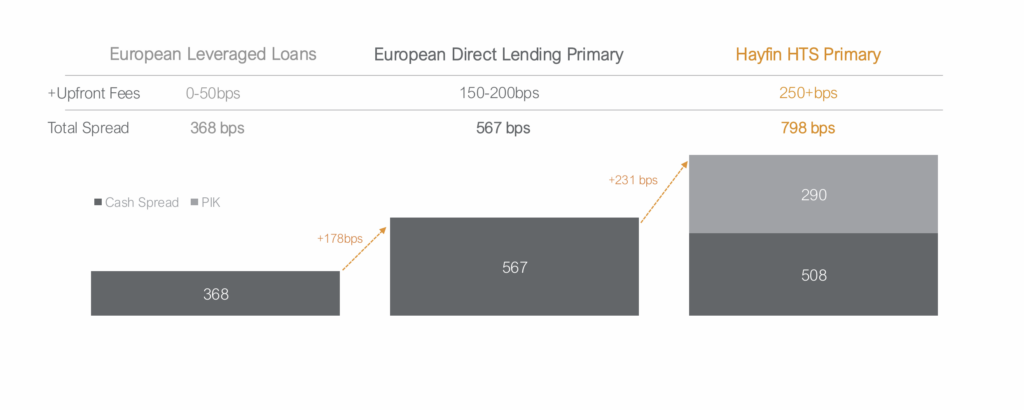
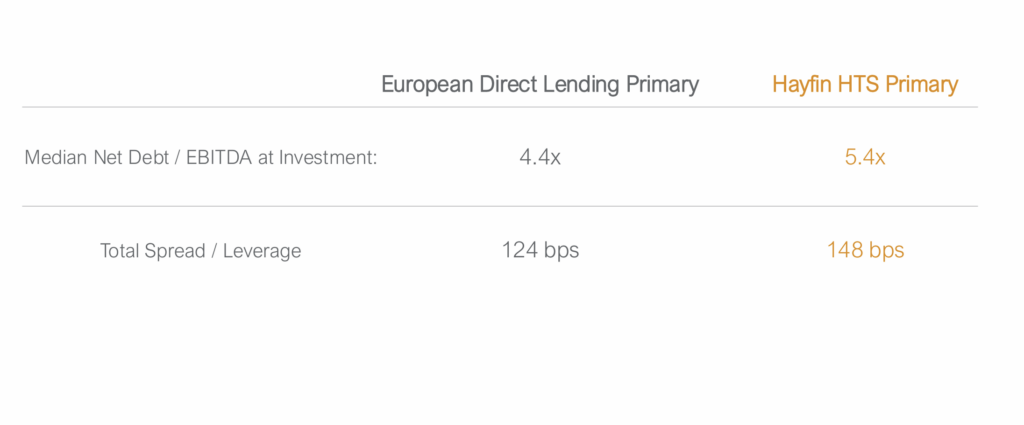
HTS investment pricing exceeds both the broadly syndicated market and direct lending, with the majority of the returns derived from cash-pay components supplemented by PIK. While leverage levels are incrementally higher on average, HTS has achieved a more attractive spread per turn of leverage, alongside higher upfront fees, supporting the view that returns are driven by complexity and capital scarcity rather than leverage alone.
Complexity must be understood to be sufficiently managed
The durability of the complexity premium depends on the ability to assess and manage risk effectively. We believe three capabilities are central to this, and are fundamental to how we evaluate, structure and execute investments in multifaceted situations:
- Sector expertise: Deep industry and asset-class knowledge, complemented where appropriate by in-house asset management capabilities, enables Hayfin to form a view where historical financial information or traditional underwriting may be incomplete or unrepresentative. Experience gained from more than 600 Private Credit investments across Hayfin’s strategies since inception provides valuable context when assessing other companies and opportunities in a particular sector.
- Bespoke structuring: Complex transactions require negotiated rather than market-standard documentation. As a result, it is possible to secure covenants, cash-flow controls, security and information rights that may be unavailable in competitive, standardised processes. For deal structuring, Hayfin relies on its dedicated in-house Legal Execution and Workouts team, who are experienced across various European creditor jurisdictions and are staffed on each deal throughout its life cycle. Most HTS primary investments have at least one covenant, at a time when covenant protection has become increasingly rare across much of the leveraged lending market.
- Prior relationships: Repeat exposure to a company, management team, borrower or sponsor reduces information gaps and is often the reason Hayfin sources the opportunity at the outset. As one of the most tenured private credit lending platforms in Europe, Hayfin frequently provides financing to the same companies over several years and at different stages of the cycle. In addition to the breadth of investments made by Hayfin in its 17-year history, the firm has developed longstanding relationships with more than 150 private equity sponsors over that period, enhancing sourcing, diligence and execution.
Case Study: Corporate Primary Lending
One of the defining characteristics of HTS is that its primary lending can earn a complexity premium without purely taking additional credit or documentation risk versus a traditional lender.
An example of this is a senior secured term loan Hayfin provided to support a take-private transaction. The public-to-private nature of the transaction meant the sponsor could engage only a limited number of financing counterparties, and whilst it had support from traditional bank lenders, there was a financing gap.
Hayfin was able to bridge this gap by providing longer-dated capital that remained structurally pari passu whilst benefiting from premium economics that included incremental loan margin and upfront fees, as well as call protection. These economics compensated Hayfin for the structuring and execution required to help facilitate the transaction for the sponsor, rather than for a weaker position in the capital structure.
This transaction highlights how HTS generates a premium by providing tailored capital solutions and executing in situations where complexity constrains traditional lenders.
Hayfin’s Tactical Solutions strategy is focused on generating a return premium in excess of traditional lending strategies by tactically allocating to investments and market segments that we believe can produce attractive returns while maintaining a conservative risk profile. The broad mandate of the strategy includes both primary and secondary lending transactions as well as asset ownership, and spans the corporate, asset-backed and securitised products markets.
For more on Hayfin’s Tactical Solutions strategy, visit hayfin.com/strategies/private-credit/tactical-solution.
* As of 31 December 2025.
Reflects new primary lending deals from 2024-2025 and excludes add on financings. Past performance is not a guarantee of future results. All investments involve risk, including possible loss of principal. See “Notes to Investment Performance” for more information on past performance, expected returns and the impact of fees on returns to investors. The investment strategy and commitments made by HTS differ from the strategy and composition of ELLI. Additionally, there are inherent limitations to the comparison of the performance of HTS and Direct Lending with the above referenced indices. ELLI represents Morningstar European Leveraged Loan Index, a market-value weighted multi-currency index designed to measure the performance of the European leveraged loan market.